

PCR Tests: How do they actually work?
Before 2020, most of us had no idea what a PCR test was or what it might be used for. But by the time we’d had our first swab taken from the back of the nose, which felt as though it was tickling our brains, we were familiar with the test, or at least we thought we were, because strictly speaking, PCR doesn’t refer to the sample collection itself, but to the process that takes place afterwards. Dr. phil. nat. Pascal Bittel has kindly taken the time to explain to BEready what a polymerase chain reaction (PCR) is.
Interview: Franziska Iff
How exactly does a PCR test work?
The aim of the test is to detect genetic material, known as nucleic acids, from a pathogen (e.g. a virus, bacterium, fungus or parasite) in a sample. To do this, the cells or viruses present in the sample are first broken down using a chemical process, so that the nucleic acids required for the process are exposed.
The sample is then purified. One method of doing this is to use magnetic beads whose surface has been treated to attract the nucleic acid. A magnet is used to draw the beads, with the bound nucleic acids, to the bottom of the reaction vessel, allowing the impurities to be skimmed off from the top. After 2–3 washing steps, the surface of the beads is disrupted. These are then drawn down again by the magnet, leaving the purified sample containing the nucleic acids at the top, which is called ‘eluate’.
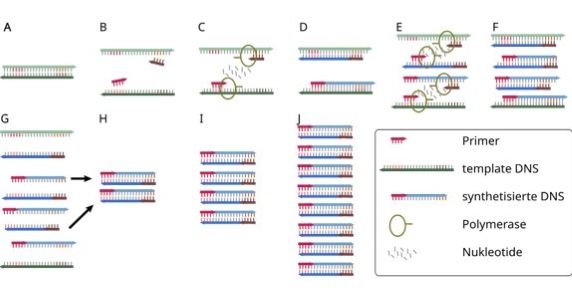
To this purified nucleic acid mixture, one now adds (synthetically produced) pathogen-specific base sequences, the so-called ‘primers’, and, by varying the temperature, a chain reaction is triggered which results in the amplification of a short section of the pathogen’s nucleic acids (but not the human nucleic acids that are also present, nor any other nucleic acid strands present). This process, the actual PCR, is complex. Put simply, the nucleic acids are the keyholes into which the base sequences (primers) fit like keys. A bond is now formed between two keys (primers), which is then split again, thereby creating an exact copy that serves as a new binding site for a further bond. This copying process occurs exponentially; that is, 1 becomes 2, becomes 4, becomes 8, and so on, resulting in ‘new’ binding sites. This process is controlled by an enzyme known as polymerase. The more material from a pathogen is present, the faster the replication process produces a sufficient number of nucleic acid copies for the detection machine to recognise. Depending on the machine’s technology and the properties of the polymerase, this requires a maximum of 45 cycles and takes between 15 minutes and 2 hours.
What do you need to pay attention to when taking a sample?
It may sound simple, but you have to take the sample from the right place. For respiratory illnesses, this is the nasopharynx. Ideally, the swab should be well moistened, but free of mucus and boogers. If you scrape along the nasal wall, there are usually enough cells for analysis. A study is due to be published shortly which shows that a well-taken swab from the nasal cavity yields results that are practically just as good as those obtained by ‘tickling the brain’ right at the very back of the throat.
Which diseases can we test for with a PCR test?
If we have the nucleotides specific to the pathogens, we can test for all viral diseases. With PCR tests, we can detect infectious diseases, but that’s not all! In the case of infectious diseases, we specifically look for the presence of genetic material from a particular pathogen. For example, viruses such as influenza, SARS-CoV-2, HIV or hepatitis viruses, bacteria such as chlamydia, tuberculosis or salmonella, and even certain fungi and parasites can be detected in this way. It is important to note that there is no single ‘general’ PCR test that detects all infections. For each pathogen, we need to know exactly what the test (the ‘system’) is supposed to look for.
However, some PCR tests can search for many different pathogens at the same time. These are known as ‘multiplex PCRs’. But that is a different topic...
PCR technology is also used in other fields, such as for detecting genetic (hereditary) disorders, in cancer diagnostics, or, for example, to identify nucleic acid sequences (genes) that confer antibiotic resistance in bacteria. The PCR technique is now indispensable in medical diagnostics because it can often detect infectious agents (and other genetically based information) with a high degree of sensitivity and specificity.