
Who is willing to join a pandemic study, and how do vaccine feelings influence this?
This research looks at who would be willing to join a long-term health study to help prepare for future pandemics, and how people's feelings about COVID-19 vaccination influence that decision. Before setting up the main "Bern, get ready" (BEready) cohort study, we wanted to understand what makes people more or less likely to say "yes" to taking part to a cohort study, not only looking at things like age, education, and income, but also at a concept called "affective polarisation": the distance between the sense of closeness people feel towards those who share their views, and the dislike or hostility they feel towards those who hold opposing ones. The results will help us design a study that represents a broad cross-section of the population in the canton of Bern.
Text by Aziz Mert İpekçi
Why did we do this research, and why is it important?
The COVID-19 pandemic showed how important it is to have good information quickly when a new disease appears. One way to be better prepared for the next pandemic is to set up a "cohort study", a group of people that researchers follow over time and can turn to rapidly when a new pathogen emerges. But such a study only works if enough people from a wide range of backgrounds are willing to take part, so that the cohort is representative of the population of interest. The pandemic also left behind strong feelings, particularly about vaccination, which divided people into camps. We wanted to know whether these divisions, and not just the usual factors like age or income, also relate whether people are willing to join pandemic research.
How did we do this research?
We invited one adult from each of 15,000 randomly chosen households in the canton of Bern to fill in an online questionnaire. The invitation went out by surface mail in September 2022, with two reminders, and the survey closed in December 2022. We asked people whether they would be willing to take part in a long-term study about infectious diseases, and we also asked about their age, education, income, household, opinions about COVID-19 vaccination, and their feelings towards people who do and do not get vaccinated. The difference between those two feelings gave us a measure of how "affectively polarised" each person was. About one in five of the invited households (23%) replied, and we analysed the answers of 3,394 people.
What did we find out?
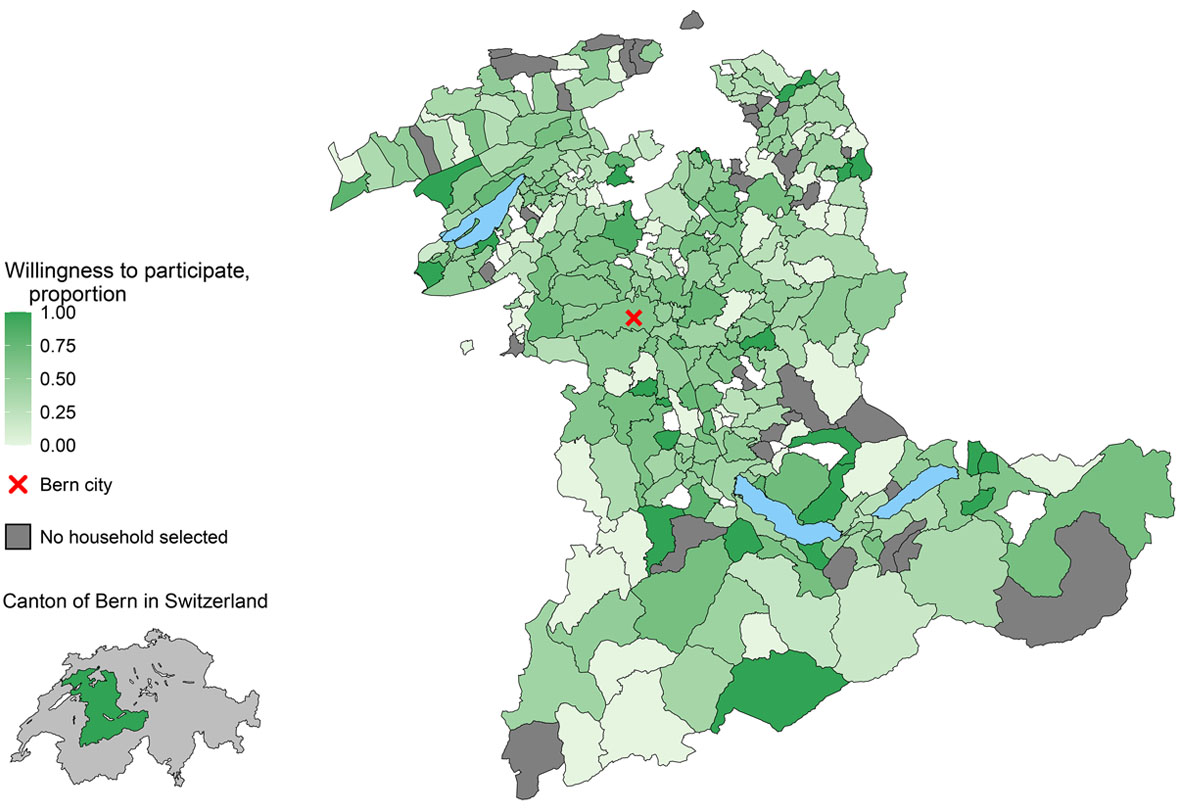
Half of the people who answered (50%) said they would be willing to take part in a long-term cohort study. Willingness was higher among younger adults, people with higher education, higher incomes, and those living closer to the city of Bern. Willingness was lower among older people, those with lower education or income, and those living in rural areas. Parents were somewhat less willing to enrol their children than themselves, and pet owners were more or less willing to include their pets depending on the species.
The most interesting findings were about feelings towards COVID-19 vaccination. People who opposed vaccination were much less willing to take part in research than those who supported it. But the role of polarisation was not straightforward: among vaccination supporters, those with strong affectively polarised feelings were even more willing to take part, while among vaccination opponents, those with strong affectively polarised feelings were the least willing of all. The main reasons people gave for wanting to take part were to help others and to contribute to pandemic preparedness. The main reasons for declining were lack of interest, concerns about privacy, and mistrust.
What does it mean?
Willingness to take part in pandemic preparedness research in Bern is moderate, and it is shaped not only by social and economic factors but also by how people feel about others with different views on health. Future pandemic studies will need to make special efforts to reach groups that are harder to engage, including older adults, people with lower incomes or less formal education, and people who are sceptical about vaccination. Community engagement, clear communication, and reassurance about data privacy are likely to be important. Understanding and addressing the emotional divisions (affective polarization) left behind by COVID-19, and not just the practical barriers to participation, could help make the next generation of pandemic research more inclusive and more useful when the next health crisis hits.
Further information
Full article reference
Ipekci AM, Hodel EM, Filsinger M, et al. Who would take part in a pandemic preparedness cohort study? The role of vaccine-related affective polarisation: cross-sectional survey.PLoS One 21(4): e0346420. doi:10.1371/journal.pone.0346420.
You can find the whole article in English here.